Most people initial consider first aid after something unsettling takes place, like a choking scare at a household dinner or a colleague collapsing at sporting activity. That jolt sends them searching for a program, then they hit a wall of blended messages: do I require a first aid certificate or only CPR, is online training valid, how much time does it last, and what about lawful threat if I obtain it wrong? After 20 years instructing first aid and CPR across offices, institutions, gyms, and community teams, I can inform you the myths create even more hesitation than the abilities themselves. The basics are simple, training service providers are approachable, and a good first aid course modifications how you relocate via your day. The technique is informing reality from folklore.
Myth 1: "CPR and first aid coincide thing"
They overlap, yet they are not the same. CPR is a certain skill set focused on heart attack. You discover exactly how to evaluate responsiveness, call for assistance, start chest compressions, provide rescue breaths if trained and willing, and utilize an AED. A CPR course dives deep into that high-stakes circumstance and refines your method so your compressions are the ideal deepness and price for an adult, kid, or infant.
First aid training has a larger range. It covers primary assessment, bleeding control, choking, shock, bronchial asthma flare-ups, anaphylaxis, burns, cracks, strokes, seizures, warm disease, and much more. In other words, CPR is a piece of the first aid pie. If you take a first aid and CPR course, you obtain both the depth of CPR training and the breadth of first aid, which is why most offices request the integrated first aid and CPR certificate.
Where the confusion creeps in: some brief CPR courses are promoted aggressively due to the fact that they are fast and low-cost. They are important, yet they do not instruct hemorrhaging control, injury care, or exactly how to handle a diabetic low. If your function includes children, sporting activities, building, hospitality, or caregiving, you likely need a complete first aid course with CPR constructed in, not CPR alone.
Myth 2: "If I have an AED nearby, I don't need CPR training"
AEDs conserve lives. They are easy to make use of, developed to speak you via every action, and perfectly risk-free for a lay rescuer. Still, defibrillators do not change CPR. An AED functions best when upper body compressions are top quality and near constant. In heart attack, blood circulation stops. CPR maintains oxygen moving to the brain and heart up until a shock can reset the rhythm. Without compressions, each minute that passes lowers survival. With compressions, you buy time and multiply the advantage of the AED.
I have seen AEDs drew from their cupboards in health clubs and airport terminals, then rest unopened because the onlookers froze, not sure when and how to utilize them. Successful saves take place when somebody begins compressions instantly, an additional individual calls emergency situation solutions, and a third individual brings and applies the AED within a couple of minutes. First aid training turns 3 complete strangers right into a coordinated team.
Myth 3: "Online-only programs are enough for a first aid certificate"
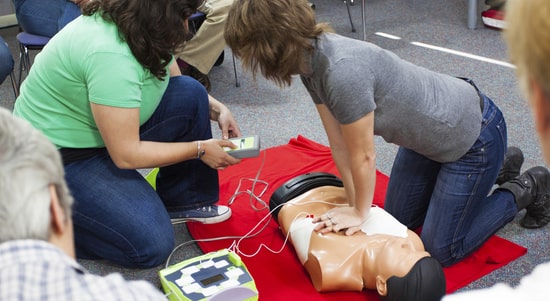
Watching video clips and clicking via tests assists you find out actions and vocabulary. However first aid is kinetic. You require to really feel where the breast bone rests under your hands, how much pressure shears sticky dressings when skin is sweaty, and just how an infant manikin replies to 2 fingers throughout compressions. Purely on the internet programs avoid that muscle memory.
Some areas permit hybrid training, where you full expertise components on-line then go to a brief useful session for evaluation. That functions well if you are tight on schedule and the supplier runs a proper hands-on part with genuine responses. Fully online first aid certificates, issued without an in-person abilities examine, are typically denied by companies and insurance companies. Ask before you book. A reputable service provider will describe what your sector or territory approves and will certainly arrange you for the ideal practical.
Myth 4: "First aid certificates last forever"
Skills decay. Everybody forgets information, and guidelines do shift as proof updates. Generally of thumb, basic first aid certifications stand for a couple of years relying on local standards, while CPR elements usually need renewal every year. Why the much shorter CPR home window? Compression technique, hand placement, and price drift over time. When I run a CPR refresher course, I regularly see individuals begin the day at 80 compressions per min, then leave at 110 to 120, which is the safer target variety for adults.
If you are a manager, compose revival days right into your schedule the day certificates are issued. If you are a private, purpose to revitalize in advance of the expiry month. Waiting until your card gaps complicates office conformity and disrupts your readiness. A fast refresher course keeps abilities sharp without repeating complete content from scratch.
Myth 5: "Do-gooder regulations won't safeguard me if something fails"
The anxiety of being taken legal action against stops people from acting, which is tragic since not doing anything is what expenses lives. Most jurisdictions have Do-gooder securities that protect ordinary rescuers that act in excellent confidence, within the range of their training, and without assumption of repayment. These laws are not an empty check. They do not secure gross neglect or willful injury. But if you supply reasonable support, call emergency situation solutions, and turn over to experts as quickly as they get here, the legal risk is extremely reduced. In technique, legal actions against onlookers for attempting CPR or first aid are vanishingly rare.
Training decreases anxiousness because it offers you a clear script to comply with: check for risk, respond, send out for assistance, open up the respiratory tract, start compressions, use the AED. That organized technique is both clinically sound and legally reasonable. A first aid course also educates you exactly how to record what you did, which adds another layer of protection and professionalism.
Myth 6: "First aid is complicated and only for clinical people"
You do not need a medical level to stop a hemorrhage or make use of an auto-injector. Most of the lifesaving tasks are easy, specifically when educated with reasonable circumstances. I remember a high school trainee that really felt upset in the first hour and prevented touching the bandages. By the afternoon, after practicing with fake blood and moulage on a schoolmate, she was leading the tourniquet drill and training others with tranquil directions. Self-confidence grows in mins when you take care of the devices and run through a scenario.
A solid first aid training provider will certainly portion web content right into convenient pieces, established hands-on practice, and repeat till you are smooth. Elegant terms discolors into the background. You leave knowing precisely what to do in the initial five mins of a medical dilemma, which is the home window that matters most.
Myth 7: "You only need first aid and CPR if you have children or work on a task website"
Parents and tradespeople see even more injuries, so they usually show up to courses. However cardiac arrest can occur to a commuter on a system, an elderly neighbor in a garden, or a weekend warrior at a park run. Allergies occur in workplaces after a common lunch. Warm exhaustion appears at outdoor wedding events. I have actually had trainees conserve a stranger on an airplane two weeks after a CPR course, and another quit a severe bleed with a belt and pressure while waiting on paramedics outside a stadium.
If you live among other people, you are statistically most likely to see a first aid scenario prior to you retire. Educating gets rid of that powerless sensation and replaces it with a plan. Even if you never utilize it, the satisfaction deserves the time.
Myth 8: "All first aid courses coincide, so purchase the most affordable"
Price matters, but value issues more. The distinctions turn up in class dimension, instructor experience, devices top quality, comments technology, and realism of situations. In some courses, one manikin serves twelve people and you exercise compressions for 90 seconds. In better programs, ratios are tighter and you get long, trained sets on grown-up, youngster, and infant manikins. Some carriers use manikins with responses displays that show depth and recoil in actual time, which hones your method much much faster than verbal cues alone.


Look at exactly how the program aligns with your requirement. A hospitality location gain from solid choking monitoring, hemorrhaging control, and melt care. A child care center have to have baby CPR, respiratory tract placing for smaller composition, and anaphylaxis management with technique on fitness instructor auto-injectors. A sporting activities club requires warmth ailment acknowledgment, concussion warnings, and splinting method. If a service provider, such as First Aid Pro in numerous areas, can tailor scenarios to your atmosphere and integrates CPR training throughout, you will walk out ready for the phone calls you are most likely to face.
Myth 9: "You can't injure a person with CPR, so technique does not matter"
Intent matters, yet so does technique. Efficient compressions drive blood to the mind and heart. Inadequate compressions are wasted initiative. Press also Hervey Bay first aid training superficial and you do not generate adequate perfusion. Press too sluggish and you lose momentum. Lean on the breast between compressions as opposed to allowing full recoil and you reduced coronary circulation. Great training engrains a steady rhythm, proper depth, and complete release. Expect to sweat a bit throughout practice.
Yes, rib fractures occasionally take place, specifically in older grownups whose bones are a lot more weak. Cracks are an appropriate adverse effects in a life-or-death situation. What you can decline is stopping since you are fretted about causing injury. A living individual with mending ribs is a success. First aid and CPR training makes that calculus clear and offers you the confidence to maintain going until aid arrives or the individual shows signs of life.
Myth 10: "I did a program years back, so I'm great"
Skills discolor faster than pride. When I run a CPR correspondence course, long-time owners of a first aid certificate consistently miss action in the primary study or default to out-of-date assistance they discovered a decade ago. For instance, compression-only CPR is now commonly approved for untrained rescuers, and AED usage has actually come to be even more structured. Anaphylaxis methods and asthma action strategies also update regularly based on medicine changes. If your last first aid training predates your current phone, put a refresher on your to-do list.
The great news: refreshers are effective. You already know the shape of the abilities, so the session is about fine-tuning and lining up with existing standards. Those sessions are where many individuals finally repair their hand positioning or find out to change rescuers without losing rhythm.
What employers and coordinators misunderstand regarding compliance
In workplaces, one of the most typical failing is counting certifications instead of computing coverage. Having 3 people accredited theoretically indicates absolutely nothing if 2 job night shift and one gets on leave. Real readiness comes from mapping protection against lineups, layout, and recognized threats. A building and construction website with hot jobs and a big impact needs more initial aiders and extra equipment caches compared to a quiet office on one Epping first aid level.
Another mistake is storing packages like gallery pieces. I see trauma pads running out on shelves, empty oxygen cylinders, and AED pads that are inappropriate with the device. A first aid course will certainly cover set upkeep briefly, however the behavior has to be inner. Set a quarterly check, designate responsibility, and log each examination with dates and signatures. Run a ten-minute drill two times a year where a person should bring the kit and AED from wherever they live and get to a named place within an established time. You will certainly discover secured cabinets or obstructed hallways long before an actual emergency does.
What counts as a high-quality first aid and CPR course
You desire guideline that treats you like an adult and challenges you simply sufficient to learn without being overwhelmed. Efficient programs share a few concrete elements:
- Small team practice on adult, child, and baby manikins with real-time comments and teacher correction Scenario-based knowing that matches your context, such as burns for kitchen areas or spinal preventative measures for sport Clear, present advice connected to acknowledged guidelines, not mythology or scare stories Assessment that feels like an outfit rehearsal genuine events, not a memory test Practical time with common devices, consisting of AEDs, epi-pen trainers, bronchial asthma spacers, and tourniquets
Talk to the provider before booking. Ask what manikin-to-student ratios they utilize, whether they supply blended understanding if you need it, and how they customize situations. Respectable companies, consisting of First Aid Pro and comparable local providers, will address quickly and especially, not with obscure advertising and marketing lines.
The conflict between concept and realism
Textbook sequences issue due to the fact that they function under stress. Fact, however, is messy. Picture a confined coffee shop with a faint scent of gas, an individual dropped between chairs, and alarm systems from a nearby vehicle backyard. You require the clean formula from class, after that consent to adapt. Perhaps you drag the casualty a brief range to fresh air before pouring focus right into the air passage. Perhaps you reduced a t shirt due to the fact that drawing it off will certainly take as well long. Training needs to explicitly give you that adaptability so you do not ice up when conditions differ the white boards version.
I design scenarios to force choices: 2 casualties with one package, a child enjoying a parent collapse, a language barrier with a panicking spectator. Individuals first aid course Hervey Bay learn that best is uncommon and adequate, quick, beats excellent, sluggish. That lesson sticks.
Equipment myths that lose money
The internet tempts individuals right into buying flashy tools they will certainly never use under tension. Tactical tourniquets are powerful, however just if you have actually exercised with them on limbs of different dimensions and recognize when to prefer direct stress or hemostatic dressings. Breast seals, nasal respiratory tracts, and decompression needles fall far outside the scope of a standard first aid course and can create damage if applied by untrained hands.
Invest first in well-stocked, familiar packages and ensure everybody recognizes where they live. If your risk account validates sophisticated devices, update your training as well. For many community and workplace settings, the basics win: handwear covers, bandages, dressings, triangular bandages, a space blanket, saline, burn gel, glue tape, candid scissors, a pocket mask, and an AED with extra pads. An orderly package that you can browse by feel defeats a tactical bag you only opened once.
How long does actual readiness take to build?
With a concentrated eight-hour first aid and CPR course, the majority of people go from reluctant to experienced. You will not feel like a paramedic, and you don't need to. What issues is your capability to lead the initial 5 minutes: make the scene risk-free, call for help, start core interventions, and hand over easily when specialists arrive. Add a two-hour CPR correspondence course yearly and the contour remains high. If your workplace runs brief drills every quarter, preparedness becomes 2nd nature.
Two or three hours is enough to upgrade an associate on particular risks, like anaphylaxis after an incident in the canteen or heat monitoring before a summer season of outside occasions. Pile these micro-sessions on top of your standard first aid certificate and watch confidence rise.
A fast fact look for your existing status
Use this to assess where you stand and what to do next.
- Do you understand the difference between heart attack and a cardiac arrest, and what to do for each? Can you situate your closest AED right now, and do you know exactly how to open the cabinet? When does your first aid certificate expire, and do you have a CPR refresher course arranged within the next 12 months? If a colleague choked at lunch, could you cycle through back strikes and stomach thrusts confidently? Who is responsible for kit checks where you work, and when was the last log signed?
If you hesitated on greater than one, book a training course or a refresher course and set calendar pointers for package checks. That tiny burst of admin pays back greatly the day you require it.
Picking the right path: course kinds without the sales pitch
A standalone CPR course is excellent if you currently hold an existing first aid certificate and intend to sharpen compressions, experiment an AED, and review choking administration in a small window. It is also a suitable for duties where cardiac arrest is the major concern, such as health and fitness professionals who already have injury methods with other channels.
An incorporated first aid and CPR course is the criterion for most offices. It covers the clinical and trauma fundamentals, runs hands-on circumstances, and includes CPR training with assessment. If you are new to training or it has been greater than two years, this course provides you complete coverage.
A CPR correspondence course is a short, concentrated session, frequently a couple of hours, that revisits compressions, airway, AED, and choking with upgraded guidance and performance comments. Lots of employers set up these annually to keep skills fresh without taking a full day out of operations.
Whichever you select, try to find service providers who release clear details, utilize acknowledged guidelines, and offer useful evaluation. Read evaluations that point out hands-on time and teacher assistance, not just certifications issued.
Why the myths keep recurring, and exactly how to identify them early
Myths continue because they are neat, soothing, or affordable. It is simpler to think an AED can address everything or that an online test amounts to readiness. Advertising and marketing enhances shortcuts, and individuals repeat what they heard years earlier without examining if requirements changed. To filter sound, ask 3 concerns each time you listen to a claim regarding first aid training or certificates:
- Does this align with published support from a recognized body in my region? Does it make functional feeling under tension, in a noisy, crowded, imperfect environment? Would I fit safeguarding this option to a paramedic at handover?
If the solution to any of those is no, seek a far better source or call a training provider and ask them to walk you via the details. The excellent ones will happily do so, and you will certainly find out something helpful in the conversation.
The reward no one talks about
People expect to find out techniques. What shocks them is exactly how self-confidence spills into everyday life. After a solid first aid and CPR course, you discover exits when you get in a location, you clock where the AED hangs at the mall, and you watch on the person coughing at the next table long enough to know they are fine. That peaceful situational understanding makes you calmer, and tranquility is transmittable throughout a crisis.
The 2nd unexpected payback is group communication. When groups educate together, they find out each other's default roles. Someone is quickly on the phone with emergency situation solutions, another takes care of bystanders, a third has steady hands with devices. When a case occurs, those patterns break right into location without discussion. Offices that dedicate to first aid training typically report better control on non-medical troubles since the habit of clear duties and crisp handovers sticks.
Practical steps to relocate from myths to mastery
Start by mapping your real danger. Home with toddlers, a workshop with power tools, a website with elevations, or a workplace near a busy junction all present various accounts. Pick a first aid course that matches, with CPR training consisted of. If budget plans are limited, phase your training mate over two months so coverage never drops. Establish calendar pointers for certification renewals and set audits. Pick a service provider with a clear process for a CPR refresher course yearly. Lastly, run one five-minute drill per quarter. It sets you back practically nothing and does more for readiness than an e-mail with a PDF ever will.
You can not anticipate when you will certainly require these skills. You can choose just how prepared you will be when the phone call comes. Remove the myths, select reasonable training, and technique enough that your hands remember what to do while your brain captures up. That is the genuine pledge of a first aid certificate, and it is quite within reach.